Sunday, January 16, 2022

Savi and the Memory Keeper


Why do you think trees exist in all myths and legends? Because they are the centre of magic. 

13 yr old Savi (she hates being called Savitri) shifts to Shajarpur with her mother and elder sister Meher, leaving behind everything familiar in Delhi. Savi, who is grief-stricken and unable to come to terms with a world without her father in it, is only more frustrated with this change. Her father died six months back and Savi wished really hard for only two things now - to keep her Dad’s 42 plants alive in their new home and she be rendered invisible for she was tired of pity in people’s looks and voices. 

But Shajarpur, her father’s hometown, which she calls LaLa land for its ‘just right’ weather and ‘always happy’ people has plans for her. A big Tree in her school gives her a superpower that makes her the most coveted among the very affluent ‘Very Cool and Hip people’ and Eco Ents club consisting of tree-hugging simpletons. What is this power & how it transforms Savi, her family & classmates, even Shajapur as it unravels is a delight to read. 

Savi and the Memory Keeper by Bijal Vachharajani explores the constant tussle between progress and preserving nature, economy and environment with an understory of loss of a loved one and grief. Indeed, a beautiful combination of themes for while we notice the green canopy, fruits & flowers, we know little about trees staying connected with each other underground through a network of roots, just like how we notice everything about a person but know nothing of the grief within. 

Grief gets a mature portrayal in this story as we see people reacting differently to the same tragedy. While Savi silently withdraws into an inner shell with a ‘Don’t mess with me’ sticker on her, her mother Dhani is either hooked to phone/laptop tackling mountains of paperwork or armed with a duster and broom on an aggressive clean up mission, Savi's elder sister Meher makes reels zealously in  a bid to earn more followers on social media, none are judged here for they all wallow in grief in different ways. Not just emotions, but we learn of many little scientific things like the mycorrhizal network that connects all trees underground and the role of pollinators like wasps and bees.  

That the author vests greater power with ‘nature’ than ‘time’ to heal is truly endearing. The use of Ficus Mysorensis tree and a purple frog species found in the Western Ghats as central motifs in storytelling is intelligent. Mentions of poha, dhokla, thalipeeth, lemon grass in Thai curry, the aroma of jasmine & freshness of mint are a feast to our senses. The author's attention to detail is noticeable when we infer why Savitri gets her name or why Bekku is the name of a black cat that stays with the family in Shajarpur. 

Man’s unending avarice, his increasing indifference to nature and the inevitable climate change are all charted well using the fictional city, Shajarpur. 

The book has a tad unbelievable element in the end but ‘those who don’t believe in magic will never find it’ and this one’s about the magic of trees as much as it’s about friendship, loss, memories, hope. Though a middle grade read, keeping in mind the cycle that the author mentions - ‘the more we forget, the less we care and the less we care, the more we forget’, this read is for grown-ups too. 


The cover design and illustration by Rajiv Eipe is gorgeous and does complete justice to the story. A reading experience becomes totally rewarding when one can figure out why the author wrote the book and the acknowledgements section does this job for the reader, please don’t miss it. 

Savi and the Memory Keeper is sure to give us warm smiles and leave us moist eyed too. A beautiful, reassuring read that is neither annoyingly optimistic nor depressingly pessimistic, and we definitely  need more such books. 

Tuesday, January 4, 2022

Homebound


“Home is the shelter you run to in a crisis, not the one you run away from, or the one that drives you out”. 

When the nationwide lockdown was extended for another 3 weeks on Apr 14, 2020, many migrant workers/daily wage labourers decided to leave big cities, factories of their dreams and walk back home, to villages several km away across state borders. Why? No work meant no money and no money meant no shelter, food and water. Hunger and penury would devour them even if they escaped the virus

Meher, a 15 yr old girl, a resident of Dharavi in Mumbai sets out on foot to her village Balhaar in Rajasthan, about 900 km away, with her family as decided by her father.  

Homebound by Puja Changoiwala is a heart wrenching account of many hardships they face during this arduous journey - sapping summer heat, agents who fleece them with the promise of ferrying them secretly in trucks marked ‘essential goods’, an excessively irate and vigilant police force patrolling the borders. Written in epistolary format, it focuses on the stigma associated with Covid, panic & fear the invincible & invisible virus generated, more specifically the non Covid deaths during the mass departure of migrant workers - due to accidents, heat exhaustion, starvation, police brutality.

Lockdown - an oft-used term during the COVID-19 pandemic; touted as an indispensable public well-being measure spelt doom for many. It will not be wrong to draw a parallel between its implications for people from different strata in society and the symptoms of infection from coronavirus - ranging from asymptomatic, mild to very severe and fatal. Even as I read this book, Delhi went into a partial lockdown in fear of an impending third wave of COVID-19. 

Millions of migrant workers who ran big cities like a well oiled machine for measly wages, worked in inhuman conditions without health care benefits, safety gear, job security and written contracts, workers whose dues remained unsettled with the sudden imposition of lockdown, who were forced to walk back home for there were no trains and buses to ferry them safely, workers who wanted little empathy and not charity get a voice in Homebound.

When the author names the first chapter as food, clothing, shelter, Internet, we know she has many relevant things to state and she does this unfailingly through the book. The writing is brilliant, there are some powerful lines like - 

"The internet is a lot like our universe and like the universe , most of it brims with a dark energy."

"Hate is heavy, a secured debt, where the country is held as the collateral, the borrower is every citizen and the interest is blood."

However, it's also true that the writing feels ornate at places, often weighed down by the use of metaphor. (For ex, tear gas shells are compared to white fairies in the opening chapter)

When Meher recounts life in her village in letters to a journalist, several issues like superstitions, farmer suicides, menstrual taboos, communal hatred, child marriage and sati surface. While this definitely ensures a holistic approach, it also gives a ‘too many cooks spoil the broth’ feeling. 

From Rainpada violence episode to national assignments of thali bajao and diya jalao during nation wide lockdown, communal clashes instances in Bhagalpur in 1989 unto Godhra riots in Gujarat, from quoting Voltaire (Superstition is to religion what astrology is to astronomy, the mad daughter of a wise mother) to Faiz Ahmed Faiz  (Aur bhi gham hai zamaane main mohabaat ke siwa, rahatein aur bhi hai vasl ki rahat ke siwa), the author renders her work dense with details and opinions. 

Meher’s letters too reflect the maturity of an adult more than a girl in mid teens thereby vociferously representing the author more than Meher. Though the climax is realistic, the act of writing letters during such a painstaking journey feels little fanciful. 

Overall, Homebound is a very important work of fiction where what's written and why it's written (as we infer from the author's note) clearly supersede the glitches in how it's written. 

Wednesday, December 22, 2021

Parthiban's Dream


My child! I fervently wish that the Chola kingdom reclaims the eminence and glory of the bygone era. This is what I dream of, day and night!'. This is Chola king Parthiban’s dream. 

The resplendent glory of Cholas under his ancestors Karikala Chola & Nedumudi Kili was a thing of yore. Now Cholanadu was a palm-sized vassal state that had to pay tributes to the mighty Pallavas of Kanchi. So when Parthiban refuses to pay tributes to the Pallava king Narasimha Chakravarthi, a battle ensues. He and his army fight valiantly and die on the battlefield. Parthiban’s fervent desire that his son, Vikraman become an independent ruler and reestablish the Chola suzerainty across oceans becomes the sole life-driving force for Vikraman.

Also, a sivanadiyar (a Saivite ascetic) who witnesses king Parthiban’s valour on the battlefield asks the dying king his last wish and promises to fulfill it. Who is this ascetic and how is he instrumental in helping Vikraman realise Parthiban’s dream? Parthiban’s Dream, a historical fiction with elements of romance and suspense, holds the answers. 

It’s pretty easy to guess who the sivanadiyar is after 1/3 rd book is read, yet the story with a multitude of minor twists has the reader completely engrossed. Love at first sight between Vikraman and the Pallava princess Kundavai, the loyalty and valour of Cholanadu subjects - Valli and Ponna, horrific human sacrifice that kabalikas (cannibals) practiced, the highly wicked antagonist Marappa Bhupathi help sustain interest. 

Descriptions of the verdant landscape on the banks of river Kaveri in Cholanadu and the sculptures at Mamallapuram, little nuggets of information on how Mamallapuram received its name, the Bhakti movement saints, how the Pallavas razed down Vatapi, the capital of the Chalukyas after defeating Pulikesi enrich the reading experience.

Hope, despair, love, sacrifice, valor, trials and tribulations, and the triumph of truth and virtue in the end make the read a complete package.  


When the author through his characters Parthiban and Vikraman asserts that one must be subservient to none, bravery and honour alone should matter, we understand his vision and zeal for Indian independence. The author, also a freedom fighter, wrote this book (Parthiban Kanavu in Tamil) in 1941 as a weekly serial in the magazine he founded, Kalki. That he wrote its prequel - Sivakamiyin Sabatham actually after Parthiban Kanavu allows us readers the freedom to enjoy it standalone. 

The translator, Nandini Vijayaraghavan, in her acknowledgements writes - “History enthusiasts owe a debt of gratitude to the (late) Kalki R Krishnamurthy. Indians who were exposed to a Delhi centric interpretation of history through school texts became aware of Cholas, Pallava , and to a limited extent , of Sinhala and Pandya histories thanks to Kalki’s meticulous research and engaging narration.” And thanks to the process of translation, this classic of Tamil literature is available to readers from across the world. 

In lucid prose and glitch free translation, with beautiful illustrations by late S Gopalan, this classic is indeed an interesting page turner. 

For me, Kalki Krishnamurthy’s Parthiban’s Dream is a much more than a book, it's a little potli bag of memories - of how my father sung praises of the movie based on the book starring Gemini Ganesan and Vyjayanthimala that released in 1960, the illustrations in it reminding me of the magazine Kalki that my mother read in little snatches of free time, of how my parents-in-law always read the authors’ works with unwavering attention as if preparing for competitive examinations. Reading this book is an experience I will always cherish. 

Saturday, November 27, 2021

The Boy from Shenkottai


On June 17, 1911, at a nondescript station Maniyachi (in Tuticorin district), Robert Ashe, the acting collector and magistrate of Tirunelveli district during British Raj was shot dead by a 25 yr old Indian named Vanchinathan. A 15 min window between switching trains, one shot fired from point blank range by Vanchi and Robert Ashe died in his wife, Mary’s arms. Vanchi locked himself up in the station’s lavatory and shot himself in his mouth thereafter. Robert Ashe’s carefully timed assassination before the coronation of George V in England sent shock waves amongst British despots in India and abroad.

Stuart Blackburn’s The Boy from Shenkottai, a work of historical fiction, traces the life journey of Vanchi and Robert Ashe culminating in the above event & its immediate aftermath. Born in Shenkottai (Travancore district) in a Brahmin family, every trip away from home gets Vanchi firmly involved in the self rule movement - his college term in Trivandrum, listening to VOC Pillai speak in Tuticorin. Ashe earns the ire of Indians when he gets popular freedom fighter VOC Pillai arrested on sedition charges, quells riots post the arrest and crushes Pillai’s Swadeshi steam navigation company.

A well structured narrative with never a slack in pace and a map of the region at the start, the book is an engaging read. While most of us know the 1927 John Saunders’ killing by Bhagat Singh & Rajguru to avenge Lala Lajpat Rai’s death, Vanchi’s killing of Robert Ashe barely finds mention. The Boy from Shenkottai attempts to fill gaps in our knowledge of the Indian independence movement left by a threadbare school curriculum but has its flaws.

By giving a lot of headroom to Ashe’s wife Mary’s thoughts & conversations between them, the author sympathizes with Ashe painting Vanchi as a murderer, a young lad misled by VVS Aiyar. This clearly leaves a distaste. Also, VVS Aiyar’s equations with Subramania Bharathi and Vanchi feel distorted with the author’s personal bias. 

I have to admit that reading a line on VVS Aiyar training Vanchinathan in firearms in Pondicherry in The Thinnai by Ari Gautier made me keen on reading The Boy from Shenkottai. Pondicherry, under French rule, outside the ambit of British sedition laws, served as a safe haven for many self styled Indian revolutionaries and their activities. They printed and published works here to make people aware of their rights, to build fervor in them to end British rule, boycott British goods and demand self rule. This aspect is dealt with in good detail in the book.

Also, reading how VOC Pillai single handedly challenged the British monopoly on Colombo-Tuticorin sea route, floated his own Swadeshi steam navigation company, offered financial assistance and legal aid to protesting cotton mill workers in Tuticorin reminded me of the old Tamil movie Kappalottiya Thamizhan, one I saw at an age when I was more familiar with the actors than the characters they played, I really need to watch it again. 

A 2019 controversy on the anniversary of Robert Ashe’s murder mentioned at the book’s end demanded more reading. That this book pushed me to read and research further definitely made it wholesome and worthwhile. 

"No, Thatha. Our past is what makes us. We must defend it as we would our lives." - as written in the final chapter, what Vanchi tells his grandfather. 

Keeping the line above in mind, The Boy from Shenkottai deserves to be read despite its shortcomings for in its core lies a significant historical event and names of many unsung Indian heroes, details of which matter more than the fictional scaffolding that surrounds it.

Friday, October 15, 2021

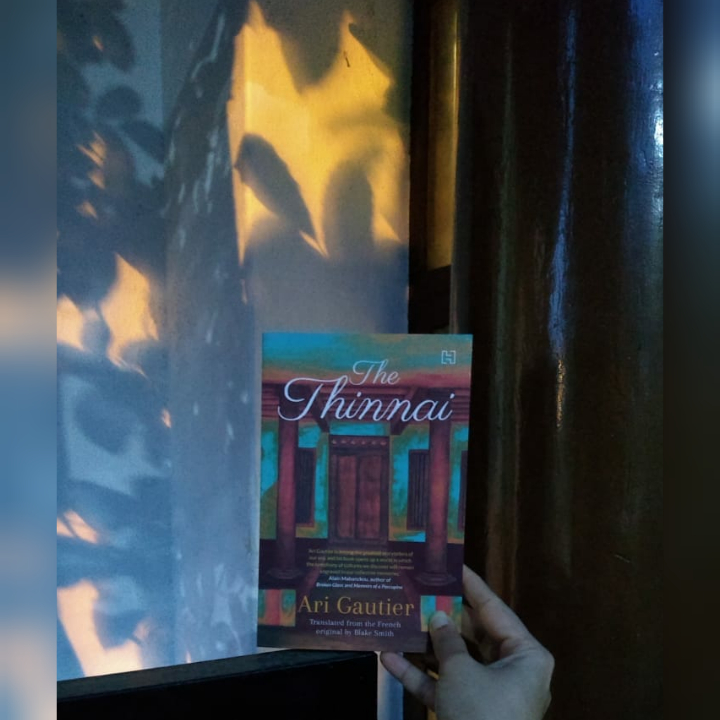
The Thinnai


The word Thinnai (in Tamil) refers to a shared verandah, a raised platform that flanks the main entrance of a house. Open to the neighbourhood, the Thinnai is where menfolk held important meetings, the womenfolk caught up on the local gossip while separating the grain from the chaff, the children played fun games, the street hawkers/sellers displayed their wares to a curious audience, travel weary souls rested their legs for a while; in short - the Thinnai was a silent hoarder of stories and memories. 


When the narrator comes back to his childhood home in Kurusukuppam (a fishermen's ghetto beyond the boulevards of Pondicherry) after years, memories of yore arise from its thinnai. It is here on Bastille's Day years back, an old, weary Frenchman, a wanderer named Gilbert Thaata, rested and narrated the story of his ancestors, the rise and fall of his fortunes and of a blue diamond - the Stone of Sita to an audience in rapt attention that included the narrator. 

Ari Gautier’s The Thinnai, deftly translated from the French by Blake Smith, begins with a lively and  colorful description of Kurusukuppam and its residents who have interesting nicknames. Using humour that switches between sardonic and deadpan, the author exposes many societal problems - generic ones like casteism (even Creoles not spared), superstitions, illiteracy, abject poverty and more specific ones like an anomaly in identity - of self, home, language and faith, an inevitable fallout of the colonial regime. 

The vibrant description of Kurusukuppam and the myriad characters who inhabit it reminded me of another read - Chandrasekhar Kambar's Karimayi , translated from Kannada by Krishna Manavalli. Just as in The Thinnai, Kambar describes the village Shivapura in great detail in his book - the streets, the houses, its residents and how they earned their sobriquets, the drunken brawls between men, men ogling at women, a life heaped in caste rules and superstitions. Both the books also celebrate the art of oral storytelling. 

When Gilbert Thaata narrates his life story, he takes us to Guadeloupe . Born here, to a French father and Indian mother, he unveils the story of Indian indentured labourers who arrived at the Antilles from Pondicherry to toil in the French owned sugarcane plantations after slavery was abolished in the year 1848. The plight of these Indian indentured labourers is detailed out in  - The Cane Cutter's Song by Raphael Confiant , translated from the French by Vidya Vencatesan. 

The narraror's father - Paulin, a Tamil who serves the French army, retires after serving for a bare minimum number of years that entitles him to a pension and settles down in Kurusukuppam. His mention of trenches, ration and gunshots in years of army service fighting for the French state lets David Diop's At Night all Blood is Black pop up in my memory. 

The narrative in The Thinnai, a multitude of stories, that encompasses history of the French empire from 1595, centuries of French colonial legacy from the fall of Bastilles to 1962 Pondicherry secession to India, moves in a wild abandon demanding complete attention from the reader. 

That the Tamil and French influences meld in every walk of life in Pondicherry is evident to anyone who visits the White Town, and the casual utterance of the word - Rue Manakula Vinayagar Koil (the road with an important tourist site and temple) testifies it. It is this amalgam of influences reflected in food and culture that's showcased well in The Thinnai. How the socio-cultural & linguistic scape changes with the creation of Auroville in the year 1968 is also touched upon.  

How the author juxtaposes opposites in writing is brilliant - the way fisherwomen and butchers conduct their business, the varied lifestyle of the narrator’s father and uncle, of Gilbert Thaata's father and Uncle, ideals of communist & capitalist thinkers.

Though Gilbert Thaata’s story is the focal point, it begins only in the second half and this definitely teases the reader’s patience. I also have to admit that as a Tamil, I was poised for a better connect with the text, be it the cusswords or references to movies like - playing the ‘Sappani’, MGR-Nambiar climax fight in Adimai Penn

That said, that The Thinnai reminded me of few other reads and gave me more than a handful to read and research about, from the Frenchman Marshall Petain's surrender to Germans to VVS Aiyar and Vanchinathan's role in Indian independence movement, made it really special. 

“I think we forget things if we have no one to tell them to” - Ritesh Batra, director of The Lunchbox, and The Thinnai doesn’t let us forget many important things.