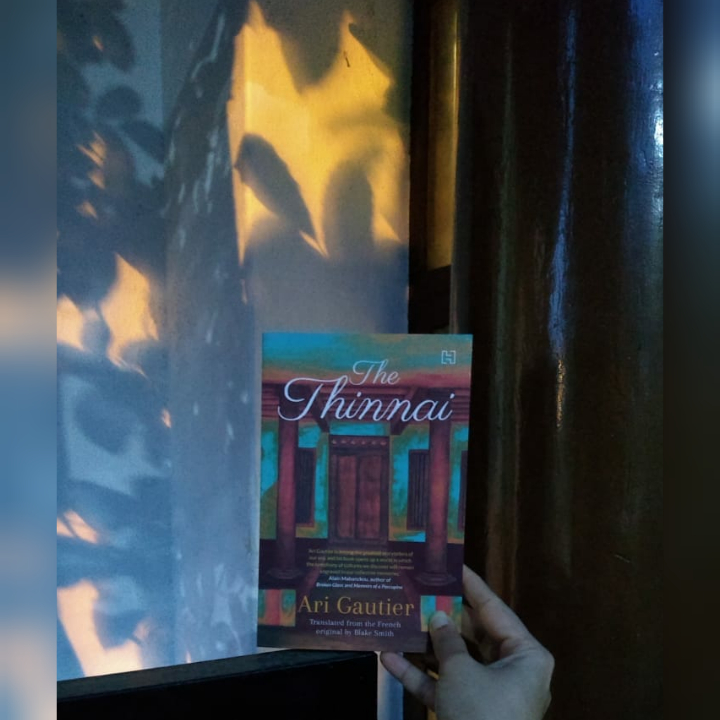
The word Thinnai (in Tamil) refers to a shared verandah, a raised platform that flanks the main entrance of a house. Open to the neighbourhood, the Thinnai is where menfolk held important meetings, the womenfolk caught up on the local gossip while separating the grain from the chaff, the children played fun games, the street hawkers/sellers displayed their wares to a curious audience, travel weary souls rested their legs for a while; in short - the Thinnai was a silent hoarder of stories and memories.
When the narrator comes back to his childhood home in Kurusukuppam (a fishermen's ghetto beyond the boulevards of Pondicherry) after years, memories of yore arise from its thinnai. It is here on Bastille's Day years back, an old, weary Frenchman, a wanderer named Gilbert Thaata, rested and narrated the story of his ancestors, the rise and fall of his fortunes and of a blue diamond - the Stone of Sita to an audience in rapt attention that included the narrator.
Ari Gautier’s The Thinnai, deftly translated from the French by Blake Smith, begins with a lively and colorful description of Kurusukuppam and its residents who have interesting nicknames. Using humour that switches between sardonic and deadpan, the author exposes many societal problems - generic ones like casteism (even Creoles not spared), superstitions, illiteracy, abject poverty and more specific ones like an anomaly in identity - of self, home, language and faith, an inevitable fallout of the colonial regime.
The vibrant description of Kurusukuppam and the myriad characters who inhabit it reminded me of another read - Chandrasekhar Kambar's Karimayi , translated from Kannada by Krishna Manavalli. Just as in The Thinnai, Kambar describes the village Shivapura in great detail in his book - the streets, the houses, its residents and how they earned their sobriquets, the drunken brawls between men, men ogling at women, a life heaped in caste rules and superstitions. Both the books also celebrate the art of oral storytelling.
When Gilbert Thaata narrates his life story, he takes us to Guadeloupe . Born here, to a French father and Indian mother, he unveils the story of Indian indentured labourers who arrived at the Antilles from Pondicherry to toil in the French owned sugarcane plantations after slavery was abolished in the year 1848. The plight of these Indian indentured labourers is detailed out in - The Cane Cutter's Song by Raphael Confiant , translated from the French by Vidya Vencatesan.
The narraror's father - Paulin, a Tamil who serves the French army, retires after serving for a bare minimum number of years that entitles him to a pension and settles down in Kurusukuppam. His mention of trenches, ration and gunshots in years of army service fighting for the French state lets David Diop's At Night all Blood is Black pop up in my memory.
The narrative in The Thinnai, a multitude of stories, that encompasses history of the French empire from 1595, centuries of French colonial legacy from the fall of Bastilles to 1962 Pondicherry secession to India, moves in a wild abandon demanding complete attention from the reader.
That the Tamil and French influences meld in every walk of life in Pondicherry is evident to anyone who visits the White Town, and the casual utterance of the word - Rue Manakula Vinayagar Koil (the road with an important tourist site and temple) testifies it. It is this amalgam of influences reflected in food and culture that's showcased well in The Thinnai. How the socio-cultural & linguistic scape changes with the creation of Auroville in the year 1968 is also touched upon.
How the author juxtaposes opposites in writing is brilliant - the way fisherwomen and butchers conduct their business, the varied lifestyle of the narrator’s father and uncle, of Gilbert Thaata's father and Uncle, ideals of communist & capitalist thinkers.
Though Gilbert Thaata’s story is the focal point, it begins only in the second half and this definitely teases the reader’s patience. I also have to admit that as a Tamil, I was poised for a better connect with the text, be it the cusswords or references to movies like - playing the ‘Sappani’, MGR-Nambiar climax fight in Adimai Penn.
That said, that The Thinnai reminded me of few other reads and gave me more than a handful to read and research about, from the Frenchman Marshall Petain's surrender to Germans to VVS Aiyar and Vanchinathan's role in Indian independence movement, made it really special.
“I think we forget things if we have no one to tell them to” - Ritesh Batra, director of The Lunchbox, and The Thinnai doesn’t let us forget many important things.