Friday, May 31, 2019

A Good 'Olio'


Book Review

"The enemy is fear. We think it is hate; but, it is fear" - Mahatma Gandhi.

And with these lines, begins this book - In a Violent Land, a compilation of essays and stories written on violence that plagues every strata of Indian society. It begins with an excerpt from - The Train to Pakistan by Khushwant Singh. Reading it kindled strong, clear images of Mano Majra village during the summer of 1947 and memories of reading the book years back. It was good to revisit Anna Bhau Sathe's Gold from the Grave and Vijaydan Detha's Countless Hitlers, stories I read from an anthology on Indian writing - A Clutch of Indian Masterpieces.

Udayan Ghosh's Swapan is dead, long live Swapan, translated from Bengali by Arunava Sinha churns you in trepidation. Shahnaz Bashir's The Gravestone shines in terse prose with irony.

Sanjoy Hazarika 's A Troubled Peace in Mizoram unravels highly important information about people's movement, governance issues in North East since Indian Independence. I have marked his other books for a read.

The winning piece for me in this collection is Mahasweta Devi's Seed. None can describe the problems faced by landless laborers, lower castes and untouchables in a hard hitting manner like her. And, love her for always making her female characters, even if brief an appearance,  unabashedly bold and gritty.
Region, religion, gender, caste, ethnicity, language and many factors, some that make our nation so diverse and beautiful have spawn seeds of violence that mar its growth.

Mistakes do happen, but they should not be repeated. Therefore, it would only be ideal that the first instance of violence, inside home or out on streets, also turned out to be the last one.

Alas, we are in times where multiple instances of violence are committed everyday, justified
through a retrogressive mindset - Is it happening for the first time, then why this over reaction? Back then it happened; none could stop, so why and how can one stop now? This callous indifference has pulled the land down along fault lines, into an abyss far away from the ideal.
.
.
Verdict : Love Indian writing and translated literature; then definitely, a good pick.

A Family , Few secrets and a Murky tale


Book Review

Can someone be so racked by guilt that one renounces living altogether?

A five page letter with a postscript by an estranged mother to her dear son with clear instructions that it be read by him when alone and only after her death rocks the very foundation of an entire family.

Udayan Mukherjee's debut novel has a plot that is crisp, prose highly mature and compact, lines - not melodramatic but strongly melancholic that dissect emotions flawlessly. We travel the entire landscape of memories of Ronojoy and Sujoy - two brothers, their memories of their parents - Mala and Subir, Apu kaka, their Dida, their house in Delhi, a summer home in the hills in Mukteshwar; we join the dots as the story progresses between their life events that initially seem are in disarray.

A past caked with anguish, guilt, betrayal, remorse and longing for love punctures a vulnerable present leaving only uncertainty for future - a heavy read,  I still strongly recommend for reasons below -

1. The author unfailingly explains how falliable we humans are, how hugely important it is to forgive an erring act by a loved one. Forgiving does more good to oneself than one who errs.

2. It needed so little to make children happy just as it needed little to scar them for life. This statement by the author with ample backing drives home the point that childhood conditioning leaves an indelible mark for life.

3. The author explains how there is no one reality, no one reaction to the same set of events, some are hurtled towards an emotional abyss while they exhibit an outer calm, bottling up emotions while others openly vent the turmoil. Judging anyone was just futility.

The book has an open ending befitting the fact that many things that happen in one's life cannot/do not attain a closure.

Udayan Mukherjee's Dark Circles stresses on how important it is to broker peace with one's past to handle the present, and also forge the present constantly to brace for the future.

A Gynocentric Take on Ramayana


Book Review

"In Ayodhya, everyone swore by Rama's protection. Who knew that Sita was Sri Rama's protective charm?" 

The Liberation of Sita by Volga translated from Telugu by C Vijayasree and T Vijaya Kumar re tells old tales from Ramayana from a gynocentric perspective; the many battles within Sita, her inner turmoil when she is subjected to many tests and trials; the initial mayhem, anger and despair leading to an unending quest for answers, gradually giving way to an inner peace, a strong resolve to never give up one's sense of identity or bow down to external authority.

The answers that help Sita liberate herself from all familial ties and become one with her mother are not obtained alone but with support from other lesser known women in Ramayana - Urmila, Renuka, Ahalya and Shurpanaka. Women strengthening women, forming a supportive backbone in times of need makes this slender book a marvel, in my opinion.

Sita's interactions with the women in four stories - The Reunion, Music of the Earth (my favorite), The Sand Pot, The Liberated are all imagined extrapolations with a definitive purpose - Sita's liberation and her return to the Mother Earth, the actual conclusion in the epic as well, thereby making the stories extremely believable, conversations in them real and relatable.

The last story - The Shackled deals with how an exalted nobleness turns a handicap for Rama. The daunting task of preserving and protecting Arya Dharma corners him to loneliness and misery, an existence bereft of Sita whom he loves dearly. The author scores full points here cause while she exhibits Sita's perseverance in face of constant strife with fine lucidity, she reflects no acridity towards Rama for the decisions he takes. 
Rama's laments that with enormous political power, he has lost power on himself and is chained to his royal duties reflect clearly that 'feminism' in true sense is not extolling females and putting down males but seeing them as equals in a society that encompasses them.

Very strongly recommend this lovely, meaningful read!


A Peek into India we don't know


Book Review

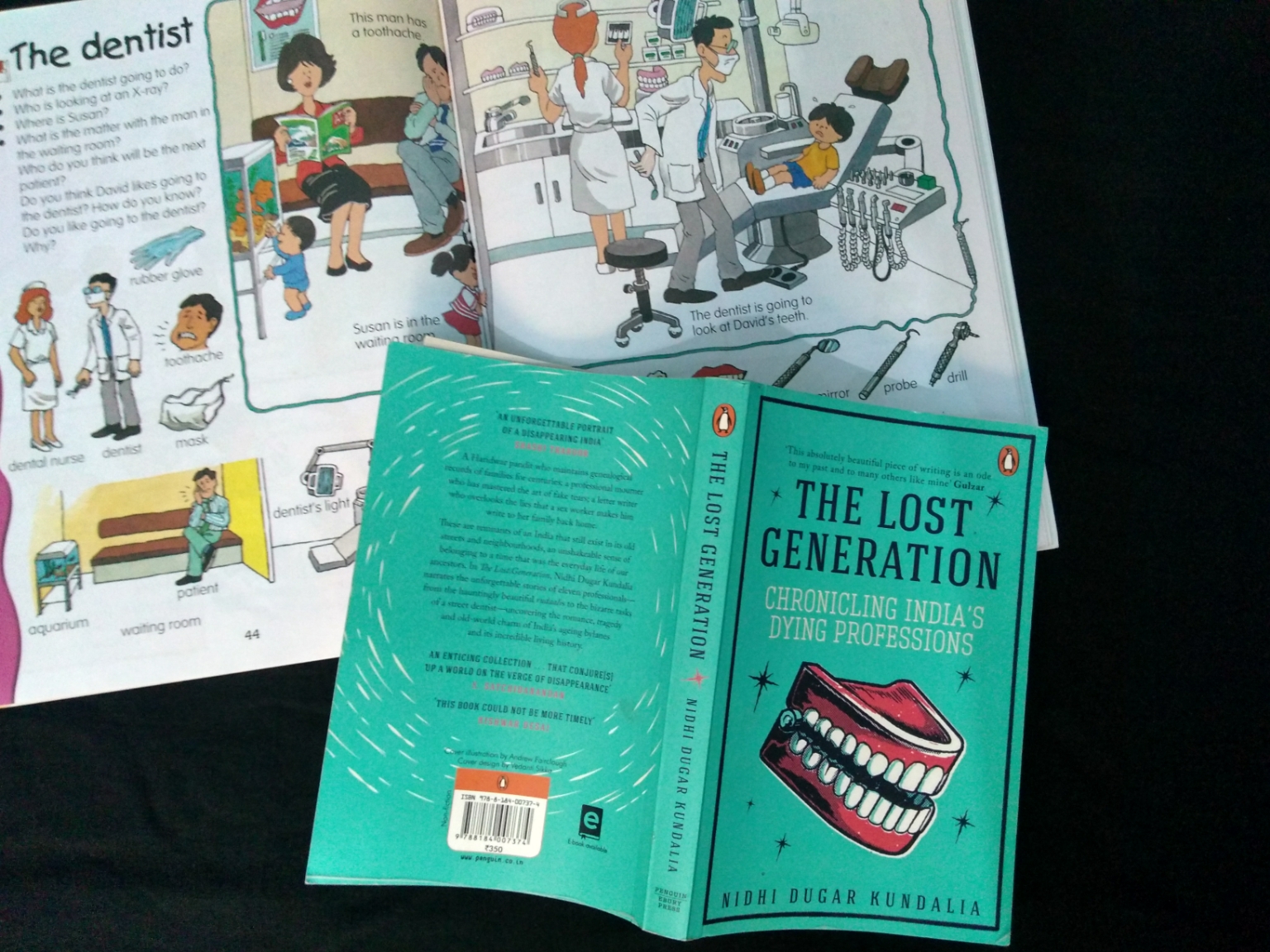
Nidhi Dugar Kundalia's book The Lost Generation details out eleven dying professions in India, each chapter feels like an episode from OMG! Yeh Mera India show on History channel, revelatory and immensely interesting.

The author travels from narrow bylanes, labyrinthine alleys in bustling cities and towns to remote jungles in Jharkhand, a nowhere place in Thar desert, a village by the river Hooghly to record details of a few professions which if not for her efforts, we would not know with this clarity. "Do what you like" they say, when choosing a career, then there is inexhaustible passion and unconditional love for one's job which is evident in chapters on the Kabootarbaaz of old Delhi, the street dentists of Baroda, the Urdu scribes of Delhi, the boat makers of Balagarh, the story tellers of Andhra and the Ittar walahs of Hyderabad.

However, for many, having to like what they do is simply the way out because their job defines their identity, gives them a place in society; they feel they were born for it inheriting a set of chromosomes fused with essential skills, their job is all they knew/know of, like the Bhisti wallahs of Calcutta, the Godna artists of Jharkhand, the rudaalis of Rajasthan.

Change is the only constant; modern technology has made people dance to a myriad new tunes it plays every day, professions with a stronghold in history find no significance and eventually vanish. That last practitioners of these jobs want a better future for their offspring manouever the inevitable change themselves.

From this book, the practice of Urdu calligraphy, Jangam Katha art of Andhra and Letter writers in Mumbai are some professions I sincerely pray survive the erosion posed by changing times and mindset.

If there is a profession I wish ceased that to exist, it is of Dagori Rudaalis. To deprive women of a family, the happiness and security they get out of it only to ensure their hearts are always full of sorrow, so they readily lament the death of higher and richer classes for few old rotis with onion in exchange, 'deplorable' is an understatement for this.

Overall an insightful and informative read, highly recommend!

PS: In the pic, alongside The Lost Generation is my kid's book. In a chapter on The street dentists of Baroda, there is an impressive paragraph that connects good teeth with great smiles and these two with decent jobs with a handsome pay. That paragraph just remained with me and the click happened.

Wednesday, February 20, 2019

Untold Tales from an Epic


Book Review
After Kurukshetra by Mahasweta Devi, translated from Bengali to English by Anjum Katyal is a collection of three stories that draws information from the longest epic in the world - the Mahabharata, sets the war of Kurukshetra - hailed as Dharmayuddh as the central leitmotif. Then combining fragments of imagination, exploring the unsaid, Mahasweta Devi creates three tales that focus complete attention on women in the epic- Kunti, Gandhari, Uttara, Subhadra and Souvali.

A keen socio-political commentator that the author is, an activist of rights of the tribals, landless labourers and the marginalised sections of the society, it is obvious that each story highlights the differences in ways of life of the rajavritta (of royal folk) and janavritta (of common man). The simple lives of janavritta allow tenderness, care, compassion, love, anger, all natural emotions, a lot of free will for every being. The lives of those in rajavritta though rigorous, austere with strict control over emotions essentially abound in lust, greed, arrogance and hatred, such acerbity among brothers and ravenous hunger for power and ultimate authority that wipes every trace of humanity.

Panchakanya - The Five Women from a farmers community who lose their husbands in the war show Uttara, the young, widowed princess how and why life must go on.

Kunti and the Nishadin is a marvelous piece of writing which reveals how narcissism can blind one thoroughly and literally.

Souvali, the last tale in the collection, speaks of the mother of Yuyutsu, the Kaurava who was never accepted by his 100 brothers, her plain principles in life hold our attention.

I loved all the three tales, the simple and thought provoking writing makes the reader tread upon lesser known paths of the kingdom of Hastinapur. Definitely, recommend this book for a read.


Also, I found something relevant to this from another book I possess - The Blue Lotus - Myths and Folktales of India by Meena Arora Nayak.

I bought The Blue Lotus end of year 2018. And it is the excerpt shared below that I read from the book at a bookstore that made me buy it immediately.The book by Aleph Book Company is divided into three parts, and this excerpt below appears in part two.

How Kurukshetra became a battlefield?
When Pandavas and Kauravas could not resolve the issue of Hastinapur's legitimate kingship through negotiations, war became imminent. When the allied forces of both sides were counted , they amounted to at least eighteen akshauhinis - each akshauhini unit consisting of 21870 chariots, 21870 elephants, 65610 horses and an infantry of 109350 soldiers. Now a battlefield had to be found that was large enough to accommodate such massive armies. Dhritarashtra, the Kuru king of Hastinapur , then sent out his envoys in all directions, petitioning various kings to lend a suitable tract of land in their region. But none were willing to lend for the Kuru war because they could foresee the massacre.


When returning emptyhanded to Hastinapur, the envoys were crossing a large area of farmland in Kurukshetra, they saw a farmer tilling his field. As he irrigated it, a levee broke and despite all his efforts, he could not stop water from flooding the field. The farmer grabbed his young son, playing close by, cut off his head with his sickle and repaired the breach using his son's dead body. When the envoys witnessed this incident , they knew this was the perfect battlefield, because it's soil was able to bear the burden of blood turning against blood. This is a folk myth from Haryana.